Showing posts with label Bassi. Show all posts

Wednesday, 11 November 2015

Ever Wondered How Alcohol Affects the Nervous System?

Not only in the UK, but all around the world, alcohol is enjoyed by many - drinking is indeed a popular pastime. However, when individuals over-indulge, it can lead to serious health problems including addition even though this is not very common. Nevertheless, in the UK, the NHS estimates that '9% of men and 4% of women show signs of alcohol dependence' (Source: DrinkAware). Over the decades, interest has increased around the effects of alcohol, not only on the physical but also on the mental state. In medicine, researchers will endeavour to find a physiological mechanism to a unexplained mental or behavioural phenomenon. A perfect example of this is the effect of various drugs, illegal and legal, on human behaviour. Quite a few of these substances cause imbalances in the amount of neurotransmitter released from pre-synaptic vesicles into the synaptic cleft in particular areas of the brain. In turn, the frequency of electrical impulses transmitted can fluctuate which can ultimately influence behaviour. To understand this better, it is beneficial to look back in history when the basic physiology and chemistry were uncovered.

Above: Scanning electron micrograph of neurotransmitter-containing vesicles (orange and blue) being released from a pre-synaptic neuron (Source: AnatomyBox)


Pre-1930s, there were noticeable disagreements between academics on how exactly neurons communicate their signals to one another. Was it electrical or was it chemical? It wasn't until 1936, when Sir Henry Dale and Otto Loewi received the Nobel Prize in Physiology or Medicine, that it became clear that these signals were indeed due to chemical transmission. This is possible through the action of neurotransmitters - chemicals which are released into the space between neuron, the synaptic cleft. Some scientists prior to this award did suggest that chemicals were involved, through observing the similarities in nerve stimulation in plants and animals (Source: NobelPrize.org) Loewi managed to illustrate the importance of these chemicals in an elegant way using experiments on frogs. His papers were published in 1921 - these showed that nerve impulses affected the heart using chemical transmission. Firstly, Loewi stimulated the vagus nerve fibres of an isolated frog's heart that had been connected on the other side to a ringer solution. Soon after this, he observed that the strength and frequency of the heartbeat decreased. The fluid remaining was used to surround another frog heart - the vagus nerves were not electrically stimulated. This time, the heart changed it's activity as if it had been electrically stimulated (Source: AnimalResearch.info) It seemed that the fluid has caused this change. Dale's discovery of the action of acteylcholine was inline with Loewi's results and so after subsequent years of research, Dale and Loewi were awarded the Nobel Prize in Physiology or Medicine. 

Chemical transmission is an important concept to understand when we consider how an impulse is able to transmit from neuron to neuron in the brain. It can be understood as a cascade of events beginning with the arrival of an action potential at the axon terminal of the pre-synaptic neuron. The depolarisation stimulates calcium ion channels to open, causing an influx of Ca2+ into the axon. This in turn stimulates vesicles filled with neurotransmitter to migrate to the end of the axon. The vesicles are then able to fuse with the lipid bi-layer membrane to release the neurotransmitter (e.g. acetylcholine) into the synaptic cleft. When these neurotransmitters bind to ligand-gated sodium channels on the post-synaptic neuron, this triggers another action potential to fire. To prevent constant firing of action potentials, a neurotransmitter such as acetylcholine is broken down by an enzyme (in this case, acetylcholinesterase), and the inactive products are reabsorbed by the pre-synaptic neuron through re-uptake transporters. These events will become important when we look at the effect of alcohol on the nervous system.

Above: Schematic diagram showing the transmission of an action potential  (Source: Biological Sciences Review Volume 26, Number 2).

Now, alcohol is one of the few substances than can cross what is referred to in anatomy as the blood-brain barrier (BBB). This is largely a fatty barrier than surrounds the blood vessels in the brain. In medical research, this barrier has been notoriously difficult to overcome when delivering drugs or attempting to treat an array of brain-related diseases, for example Alzheimer's. Until very recently, this has caused problems, however scientists have now found a way of delivering cancer-fighting drugs to targets by breaching the blood-brain barrier. A research team in Canada used 'tiny gas-filled bubbles, injected into the bloodstream of a patient, to punch temporary holes in the blood-brain barrier'. Following this, ultrasound was used to make the bubbles 'vibrate and push their way through, along with chemotherapy drugs' (Source: BBC) This has been a significant breakthrough - I encourage you to read more on the subject here.

The reason that alcohol is able to cross this barrier is that it is lipid soluble. Once alcohol crosses the barrier, it is able to affect the action of neurotransmitters. Before looking at how alcohol comes into play, it is useful to consider the different types of neurotransmitter that exist in the nervous system, and their different modes of action.

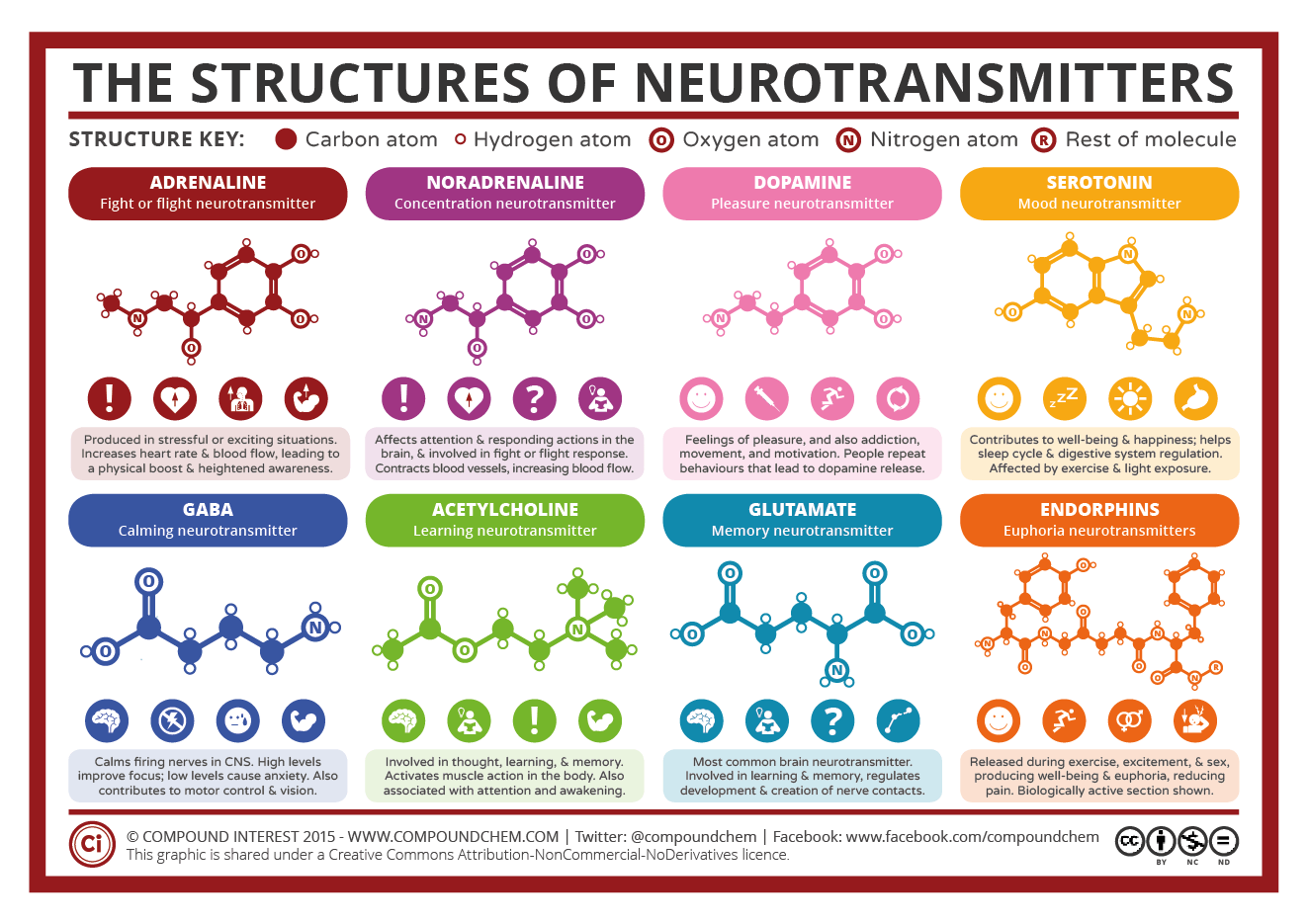
Neurotransmitters can either be excitatory (increases the likelihood of an action potential being fired on the post-synaptic neuron) or inhibitory (decreases the likelihood). Examples of excitatory neurotransmitters are glutamate, dopamine and acetylcholine. Glutamate is the most common kind of neurotransmitter in the brain and is thought to be involved in memory and learning. The well-known neurotransmitter dopamine is involved in the mechanisms of motivation and reward. It follows that many addictive drugs utilise the 'feel good' sensation that dopamine causes. And finally, acetylcholine is most commonly used in the contraction of involuntary muscle - it can be released at the site of a neuromuscular junction. A good example of an inhibitory neurotransmitter is gamma-amino butyric acid (GABA) - it's action is known to reduce stress. In fact, about a third of all brain synapses use GABA, and anti-anxiety drugs such as Valium enhance it's action. Another example of an inhibitory neurotransmitter is the amino acid glycine, however this is used mainly in the spinal cord, and is involved in about half of all synapses there, the rest using GABA. (Source: Principles of Anatomy and Physiology 13th edition - G.J. Tortora and B. Derrickson)

Above: The structure of common neurotransmitters (Source: CompoundChem). See source link for larger image.


Alcohol is widely known as a depressant drug. It is able to decrease excitatory action, and increase inhibitory action. Here, we can look at how alcohol affects the release of GABA. Ethanol increases the amount of GABA neurotransmitter released from pre-synaptic neuron in the brain, by increasing the likelihood that GABA containing vesicles fuse with the bi-layer membrane. To further induce an effect, ethanol encourages GABA to bind more easily to it's corresponding ligand-gated ion channels on the post-synaptic neuron. Subsequently, chloride ions flood into post-synaptic neuron cytoplasm, decreasing the chance that an action potential will fire. In parallel with this effect on GABA transmission, alcohol also affects the action of the excitatory neurotransmitter, glutamate. Ethanol decreases glutamate's excitatory activity, and this effect is quite dramatic considering that glutamate is used in 90% of synapses! (Source: Biological Sciences Review Volume 26, Number 2) The binding of glutamate to it's receptors on the post-synaptic neuron is blocked, thus an action potential cannot be triggered. Since glutamate is used in routes in the brain associated with learning and memory, it is common that people will suffer memory loss after a booze-fuelled night.

The imbalances between inhibitory and excitatory activity do explain the drowsiness, slow reactions and sometimes poor memory people have when drinking a significant amount of alcohol. However one observation we may have forgotten is that to many, drinking alcohol can make them feel good. From research, we know that the reward centre and the pathways associated with it are located in an area of the brain called the striatum. So far, there has been no clear link between alcohol and an effect on the action of the neurotransmitter dopamine. Recall that dopamine is involved in motivation and reward. Where is the link? Well, it is thought that the reward feedback system is usually 'kept in check by GABA inhibition. When this inhibition is suppressed, the reward system becomes more active'. Remember that alcohol does cause suppression of GABA inhibition as it encourages more GABA to bind to the post-synpatic neuron!

Above: Schematic of the brain showing the location of the striatum (yellow-orange region) (Source: Biological Sciences Review Volume 26, Number 2)

To conclude, we can see that in order to understand how alcohol can affect the nervous system, it is important to appreciate the biological cascade of events that occur during chemical transmission at the synapse. Although alcohol can be enjoyed in moderation, the public must be aware of the potential health complications associated, including liver disease, weight gain and sleep disruption. The incidence of liver disease particularly, is rising in the UK. Bear in mind that this disease not only affect adults, but also the young as well. Let us not forget also of the societal problems that can arise due to alcohol abuse, which include antisocial behaviour and violence in extreme cases.

Even today, alcohol still presents unsolved mysteries to researchers. However with continuous advances in technology, medicine, and neuroscience, how the brain is affected by substances is becoming clearer and clearer.


Additional credit: Oliver Freeman is a writer for the Biological Sciences Review and is also studying for a PhD in neuroscience.
 - Michelle Roberts, for her article published on the BBC website, 'Scientists breach brain barrier to treat sick patient'. Read more on the subject here.

Saturday, 7 November 2015

Revolutionary Platinum-based Chemistry: A New Hopeful for Cancer Therapy

As many would agree, one of the most well-known treatments that cancer patients undergo is chemotherapy. Today, it is not unusual for platinum compounds to be used in chemotherapy - cisplatin is a notable example.


Above: False-colour electron micrograph of cancer cells (Source: Wellcome Collection)


In medicine, particularly pharmacology, the shape of molecules are extremely important. In cisplatin, the oxidation state of platinum is +2 and the molecule is said to be square planar. This means that all of the atoms lie in the same plane, forming a square if you were to join up the atoms with imaginary lines. Each of the groups, Cl- (Chloride - with an oxidation state of -1) and NH3 are called ligands, and because each of the different groups are on the same side of the molecule, the platinum compound is said to have a cis structure. In the body, cisplatin's basic chemistry works as follows:

Since, in the bloodstream there is a high concentration of chloride ions, none of the ligands on the molecule are substituted (NHgroups are more resistant to this substitution). However, once inside the cell the environment is very different. In fact, there is a much lower concentration of chloride ions, and the chloride ligands are replaced by water molecules. Now the cisplatin compound is activated. This is a perfect illustration of Le Chatelier's principle:

"If a dynamic equilibrium is disturbed by changing the conditions, the position of equilibrium moves to counteract the change"
(Source: Chemguide)

Above: Displayed formula of cisplatin


Although cisplatin  has proved effective, over the years, several similar drugs such as carboplatin have been produced to maximise efficiency and potency. The drug works by disrupting cell replication, thus leading to cell apoptosis (death). The mechanism for this relies on the substitution of those chloride ligands for water molecules once inside the (cancer) cell. From this point, nitrogen atoms from the nucleotides forming DNA substitute the water molecules. Water molecules tend to be easily replaced. In this situation, cisplatin  is effectively bound to the DNA, causing the nucleotide chain to bend due to formation of a 'kink'. In DNA replication, the shape of DNA is very important and many checks are made by feedback mechanisms to make sure the cell has proceed to divide by mitosis. Once cisplatin is bound, mitosis can no longer take place - cell death results.

However, current research into the field of photoactive compounds has proved promising - the research could be a step to producing cancer drugs that can be activated at the tumour site using lasar technology. Firstly, let us consider the properties of platinum. It has a silverly coloured surface (without tarnish) and is used in catalysis - catalytic converters in road vehicles is an example. So why does this metal prove useful in the body? Platinum is considered a relatively safe, it is said to be biologically compatible due to it's inability to react with body tissue. However, in medicine, what we are more concerned about is whether we can use platinum compounds. In fact, these compounds are used but scientists are aware of the toxicity of such substances. Platinum ions that are bonded to several ligands help to channel potential toxicity in a useful way, often to produce life-saving drugs.

The challenge now is to produce treatments that are even more localised to the cancer cells. This is inevitably the subject of research in universities and pharmaceutical corporations across the globe. Existing cancer drugs work well simply because cancer cells are subject to more damage than normal body cells - cancer cells proliferate at a faster rate. Note however that normal body cells can still become affected. As many may have experienced, the side effects of chemotherapy can be quite extensive, nausea and kidney damage to name a couple. The human body is simply trying to reject the foreign substance introduced, and this is what drives scientists to look for new solutions. 

The key fact to know is that whilst cisplatin and other similar drugs are not tumour specific, how they are activated can be controlled. Platinum, like many other transition metals, have multiple oxidation states. Platinum(IV), Pt4+ complexes 'have been proven to be inactive and non-toxic inside cells, but only in the dark' (Source; Chemistry Review Volume 24, Number 4). One reason for this is to do with the shape of these platinum(IV) complexes. With an oxidation state of +4, platinum is able to form 6 bonds to ligands in an octahedral arrangement. Remember than a platinum(II) compound can only form 4 bonds with ligands in a square planar structure. This higher oxidation state enables the molecule to be less reactive and therefore ligands tend to be become replaced. This is very relevant, recall that cisplatin has it's chloride ion ligands replaced by water molecules once inside the cell. However, it is important to remember that the reduced reactivity in the case of platinum(IV) compounds is true in the dark. These compounds can be photo-activated - light enables the configuration of the molecule to change. This process is irreversible:

Above: The photo-activation of a platinum complex - X and Y denote alternative ligands (Source: Chemistry Review Volume 24, Number 4)

This reaction is able to occur to due to the phenomenon of electron transition. An election which absorbs light energy is able to be promoted to a higher energy state, and therefore a higher energy orbital with an atom. In transition metal chemistry, it is common knowledge that when ligands bond to the central metal ion, this causes the d-orbitals of the metal ion to split. The orbitals are split into two levels, one with a higher energy level than the other. The very fact that these complexes can absorb light energy means that transition metal complexes are often colourful. During the above reaction, electrons in the central metal ion 'jump' to a higher energy level. Any remaining light that is not absorbed is reflected back. These electron transitions can cause multiple changes, such as a change in oxidation state of the central ion, or substitution of ligands. Controlling this activation could indeed be a useful tool in cancer therapy, it could potentially have wider applications in medicine. After activation, the cisplatin-like compound can then perform it's anti-cancer wonders. 

Above: Diagram showing that the energy of a particular wavelength of light is equal to the energy required to promote an election to a higher energy level (Source: Chemguide)


Using these platinum compounds does leave room for flexibility. For example, scientists would be able to change the ligands to vary the amount of light energy absorbed (to cause d-orbitals to split). However, getting this energy quota just right is a challenge, and is still the subject of research. 

So what are the applications in cancer treatment? Any treatments should be as safe as possible, so it is important what type of light should be used to activate the platinum complexes inside the body. Now, most complexes tend to be activated by blue or even UV light, however these frequencies of light do not penetrate tissue as well as red light does. Bear in mind that UV can damage tissue - red light seems a relatively safe option. A compromise must be made as red light would mean that it is less likely that a complex would be activated. Nonetheless, 'some promising Pt4+ complexes have been made, which are non-toxic in the dark but once activated have a high toxicity towards cancer cells'. After all, it is completely dark inside the body, therefore a laser would need to be used to activate the chosen drug. A laser would be a suitable choice due to it's precision - it would be much less likely that a healthy body cell would be affected (Source: Chemistry Review Volume 24, Number 4)

As with any new treatment, this new concept would need to be subject to vigorous testing through a series of clinical trials. Safety and effectiveness are two crucial criteria that will need to be evaluated during the course of these trials in future. 

Additional credit: Louise Tear who wrote an article in the Chemistry Review, which was inspired by an undergraduate research project completed under the guidance of Professor Peter Sadler.
Further credit: Professor Sadler who wrote a short piece for theInformationDaily.com, 'Using precious metals to fight cancer', following research at The University of Warwick. 

Further reading: BBC, 'Chemists create new way to fight drug resistant cancer'.
Macmillan Cancer Support - 'Cisplatin - Cancer Information'

Tuesday, 22 July 2014

The Ongoing Pursuit For Stem Cell Medicine

In recent times, attention has been drawn to a particular area of biological science involving the use of stem cells. In biology, these are a type of undifferentiated cells which are capable of being multipotent or even pluripotent (embryonic stem cells only). This truly remarkable characteristic has intrigued and ultimately inspired scientists to develop techniques that can be applied to the medical field.

However we must appreciate that there are two types of stem cell. Adult and embryonic. Embryonic stem cells are derived from a 'small hollow ball of cells' called a blastocyst. This is one of the immediate results of fertilisation. What scientists are interested in is the inner cell mass - these cells are undifferentiated but more importantly they are pluripotent. This means that they have the capacity to develop into any type of cell in the body. Conversely, adult stem cells are considered multipotent, meaning they have the capability to develop into one type of cell however the variety is limited. In the human body, the most common extraction point for adult stem cells is bone marrow (although many other tissues and organs are known to produce stem cells, including the brain, heart and skin). Interestingly, foetuses have also been found to have stem cells.

Some adult stem cells such as fibroblasts can actually be reprogrammed genetically for them to 'behave like embryonic stem cells'. These are known as induced pluripotent stem cells.

Another fascinating property of stem cells is that during asymmetric division, two daughter cells are produced with contrasting characteristics. One cell is the result of self-renewal, whilst the other the result of differentiation. This explains how our body is able to heal and repair itself - any type of cell can be made available to any site where it is needed. This ability for these cells to replicate themselves and differentiate is a marvel of genetics. So how is this controlled? An engaging article in a Biological Sciences Review magazine gave me an insight.

Differentiation of stem cells is dependent on 'changing the expression of the self-renewal and pluripotency control genes'. Scientists have carefully monitored which genes switch on or off during differentiation for a variety of cell types. The result is, we can identity which genes control differentiation for a vast array of cell types. An example given is that for the production of cartilage cells (chondroctyes), adult stem cells need to 'express high levels of the gene SOX-9. This gene encourages the expression of a different gene called COL2A1 as a consequence. As genes code for polypeptides, it follows that COL2A1 codes for the production of the type-2 collagen protein. Cartilage largely comprises of this protein.


When adult stem cells are used in medicine, scientists tend to use induced pluripotent stem cells (see above) as their diversity for differentiation is a significant advantage. However for medical applications in the body, sometimes we require the aid of biomaterials to supplement the use of implanted stem cells.  The example used in this article is treatment of back pain due to a slipped disc. The pain is caused by an indentation into the spinal cord by a disc, causing a compression. Intevertebral disc cells are produced by stem cells in a lab, which can them be cultured and left to proliferate. One approach to treating the condition is to 'seed' the cells into a synthetic hydrogel. This compound exists as a gel at body temperature, it is also thermosensitive. This gel can then be 'injected into the damaged disc, where it would form a gel and act like a shock absorber, similar to a natural disc'.

The potential of stem cells in medical application is exciting and promising with continuous ongoing research. Diseases such as Alzheimer's and muscular dystrophy could one day be in combat with emerging stem cell treatments to improve the lives of those who endure the pain of these conditions.


Credit to Dr Stephen Richardson, lecturer in cell tissue engineering at the University of Manchester who wrote for the Biological Sciences Review (Volume 26, Number 4)

Saturday, 19 July 2014

New Assisted Dying Bill in Review

One of the latest news stores this week is the review of the assisted dying bill, which if passed will give permission for doctors to administer doses of powerful drugs to end the lives of those whose quality of life is seriously compromised. Essentially euthanasia, this will allow people who are seriously terminally ill to consider whether they would want to sustain their lives any longer. For me, this is a topic in which people should approach with caution as it is real lives, real people, real stories that we are dealing with.

On a basic level (although I respect this isn't a simple topic at all) we are evaluating the quality of a persons life against the longevity or quantity of their life. Indeed it leaves the nation divided in opinion. Speaking to The Independent, oncologist Professor Karol Sikora  believes that the implementation of this power for doctors will result in "death squads" of doctors.

What is important to note is that assisted dying will be of significant relevance to the terminally ill who have been told the have 'less than six months to live'. If this bill is passed, it will mean doctors will have a further big responsibility, more vitally important choices to make.

Doctors in my opinion may only make up a fraction of this matter. In medicine, the patient is the paramount figure of every case - ultimately it is their choice whether to end their own lives or not. I believe they should have the choice, providing they are sane and in "the right frame of mind". No doubt, their families will have a part to play in every patient's decision.

However British Prime Minister David Cameron is concerned that if passed, the bill may cause people to be "pushed into things that they don't actually want for themselves."

Some may argue that assisted dying will help to suppress the needless suffering of the terminally ill - this could have an effect on families as well will lessened responsibility and emotional suffering perhaps.

What do people think? Well according to a 'poll for ITV this week, 70% of Britons are behind the assisted dying bill, with 10% disagreeing'.

In my view, I believe that the bill should be passed. The attention must be brought to the patients themselves. It is they who endure terrible suffering, it is they who should be given a choice.

Credit to Natasha Culzac, reporter for The Independent for the original article. Click here for more on the story.

Wednesday, 16 July 2014

Meeting the Target - The NHS and A&E

With the population as large as ever in the UK, subsequently in the last few years there has been a noticeable and increasing strain on NHS services across the board. However I believe, along with many others, that the Accident and Emergency Department can be considered to be under the biggest of pressures today. A programme on the BBC I watched recently showed exactly the effects of this population pressure on staff and patients alike. The Panorama documentary was a rather short 30 minutes, nevertheless a real eye-opener to the general public to appreciate the scale of the problem.

I encourage you to see it and I have embedded the video below:


What I found quite shocking is that many of the staff are under constant pressure from the many patients who arrive to the hospital every hour. However it isn't just the local pressure - government-set deadlines and targets ensure the conveyer belts of NHS services are rolling quickly. One doctor in the film says "it's a more stressful place to work than it once was"when referring to the A&E Department of today.

Judging from the documentary, the staff seem stressed, however I deeply respect their professionalism as when dealing with the wide variety of patients, they control their emotions. This is vital when dealing with the public and representing an organisation as important as the NHS. One example from the clip I especially remember is when a heavy alcoholic was admitted to A&E. His rowdy, agitated and rather unpredictable manner meant the nurses in particular were dealing with a tough patient. Refraining from raising their voice too much, they managed to control the patient. In fact if he had turned very aggressive, the staff may have been at risk from harm. The number of alcoholics and drug abusers admitted to A&E is alarming, and they are transported to hospital 'around the clock'. For this hospital alone there are '3 to 4 overdoses a day'.

The pace at which staff need to work is tremendously quickly, whilst being efficient. It shows how training is vitally important to sustain such roles in the health service.

In the video, I was rather interested to see that one GP said that she once wanted to work for the A&E department of the NHS as it suited here own interests. However she ended up settling for a job less manic as a GP, as she no longer wanted to be part of a "sinking ship". She is clearly an experienced health professional, and I respect here view which is why I appreciate the scale of the problem we face in A&E.

One of the major problems in fact is the limited number of hospital ward beds available to patients after they leave the A&E department. Some patients are left to wait hours. The large number of patients poses a dilemma. The NHS need to strike a balance between treating as many people as possible and giving each patient the thorough and correct care they need to make a good recovery.

Solutions to the problem are already being implemented. However many people simply aren't aware of alternative healthcare services that have been made available by the NHS. Walk-in centres and dialling 111 are just a named couple that one could use in out-of-hours for GP's instead of visiting A&E. More awareness is needed to inform the public that personal health advice is available very readily on a local level and is easily accessible.


Sunday, 29 June 2014

Beginnings...

With my growing interest for medicine over the last few years, I have arrived at a point where I think it may be appropriate to express some of my views on today's changing events in the medical field. The field of medicine is one of profound innovation yet very personal to many. It is greatly affected by economics and politics - our NHS system has had significant reforms in recent times. Changes in the structure of the NHS have had a knock-on effect even right down to the patient level, whether it is receiving the right treatment or whether one can afford the treatment at all.

In fact one of the most controversial issues surrounding the NHS and the government is whether the NHS as an organisation will enter privatisation. When most people think of privatisation, they are reminded of the US-style health insurance 'fee for service' plans. For many this may mean no easy access to essential healthcare anymore, but could indicate 'big bucks' for emerging private health companies such as Virgin Care, a sub-category of Richard Branson's Virgin empire. An essay I have written on whether the NHS should be privatised can be seen here. I encourage a read to anyone who isn't particularly sure of what privatisation is and it's implications.

Also I will look forward to commenting on any medically related books I read that spark an interest in me.